
Bionic City
®
how nature would design a city?
est.2010
Founded in 2010, Bionic City® emerged as the world’s first design studio, consultancy, think tank, and collaborative laboratory dedicated to exploring nature-inspired design in architecture and urban environments.
Pioneering work across biodesign, biomimetics, biotechnology, and urban ecology, Bionic City® converged state of the science and wider STEM, together with experimental design, and analogue, digital and hybrid arts and media to create visionary concepts for sustainable cities of the future.
Through the application of real-world biotechnological innovations and methodologies such as post-normal science, transdisciplinary research, speculative design, and scenario planning, Bionic City® investigated the future of urban living, sustainability, and resilience. The initiative aimed to foster a symbiotic relationship between nature and the built environment, advancing groundbreaking research and creative practice.
Founded by design scientist and systems theorist Melissa Sterry, Bionic City® collaborated with leading experts in science, architecture, design, engineering, and the visual and performing arts across the globe. With partners spanning the UK, Europe, the United States, Asia, and beyond, it stood at the forefront of biologically-inspired urban design and sustainable development for more than fifteen years.
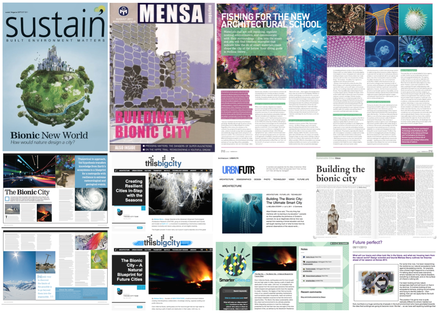
Bionic City®’s work was featured in numerous international publications and presented at over seventy major global conferences, seminars, and festivals. Over the years, it built a diverse network of collaborators, from students and researchers to industry leaders and global corporations, all united by a shared mission to reimagine how cities could thrive by emulating nature’s design systems.
In 2019, Melissa Sterry founded Bioratorium®, a boutique consultancy specialising in biofuturism and bioinnovation, with Bionic City® becoming its sister project alongside her wildfire resilience research initiative, Panarchic Codex®. While Bionic City® later scaled back its public-facing activities, a curated archive of selected works including essays, articles, art works, and design concepts from 2010 to 2019 remains accessible via external platforms.
Bionic City®’s design studio, consultancy, think tank, and collaborative laboratory now integrated into Bioratorium®, its magazine and select social media continue to share the latest advancements in nature-inspired urban design and biomimetic architecture.


-
“The biomimetic imaginarium of the Bionic City as 'the Ultimate Smart City' poses a range of distinct and pertinent questions to our futuristic design strategies.”
Urban Times
-
“Three assets define Bionic City: exploring, applying and experimenting - exploring how the principles of biosciences can be used to design, plan and build cities of the future, applying these principles to blend technology and nature to better develop new plans of construction, and experimenting with art-influenced by bioscience...”
CLOT magazine
-
“By applying resilience theory, biomimicry, and living architecture principles to every aspect of building... creating a city model that not only anticipates but welcomes intensifying natural phenomena.”
Green Prophet magazine



The magazine
Launched in spring 2013, Bionic City magazine has over 130K viewers and over 3 million shares, and is one of a select number of independent titles accredited in Flipboard's ‘Tech & Science’ section. Collating over 2.5K articles on biomimetics, biotechnology, and biology for the built environment in an open-access format, the magazine was one of just 75 titles selected from over 5 million to feature in Flipboard's #MagsWeLove collection (2013, 2014, 2015), was featured in its 'Life on Earth' 2015 Special Edition, and is one of the Top 40 'Most Read' magazines on the platform.
-
“Completely awesome magazine on biomimetics by Melissa Sterry”
Mike McCue, Founder, Flipboard
-
From luminescent forests to glow in the dark buildings, Melissa Sterry's Bionic City is full of the kind of wonders you thought you could only dream up. Before reading this magazine, I had no idea that biology and science could be so well integrated into urban landscapes.
#MagsWeLove, Flipboard
